DeepAVC: A Unified Platform for Antiviral Compounds Prediction
Welcome to DeepAVC !
Introduction
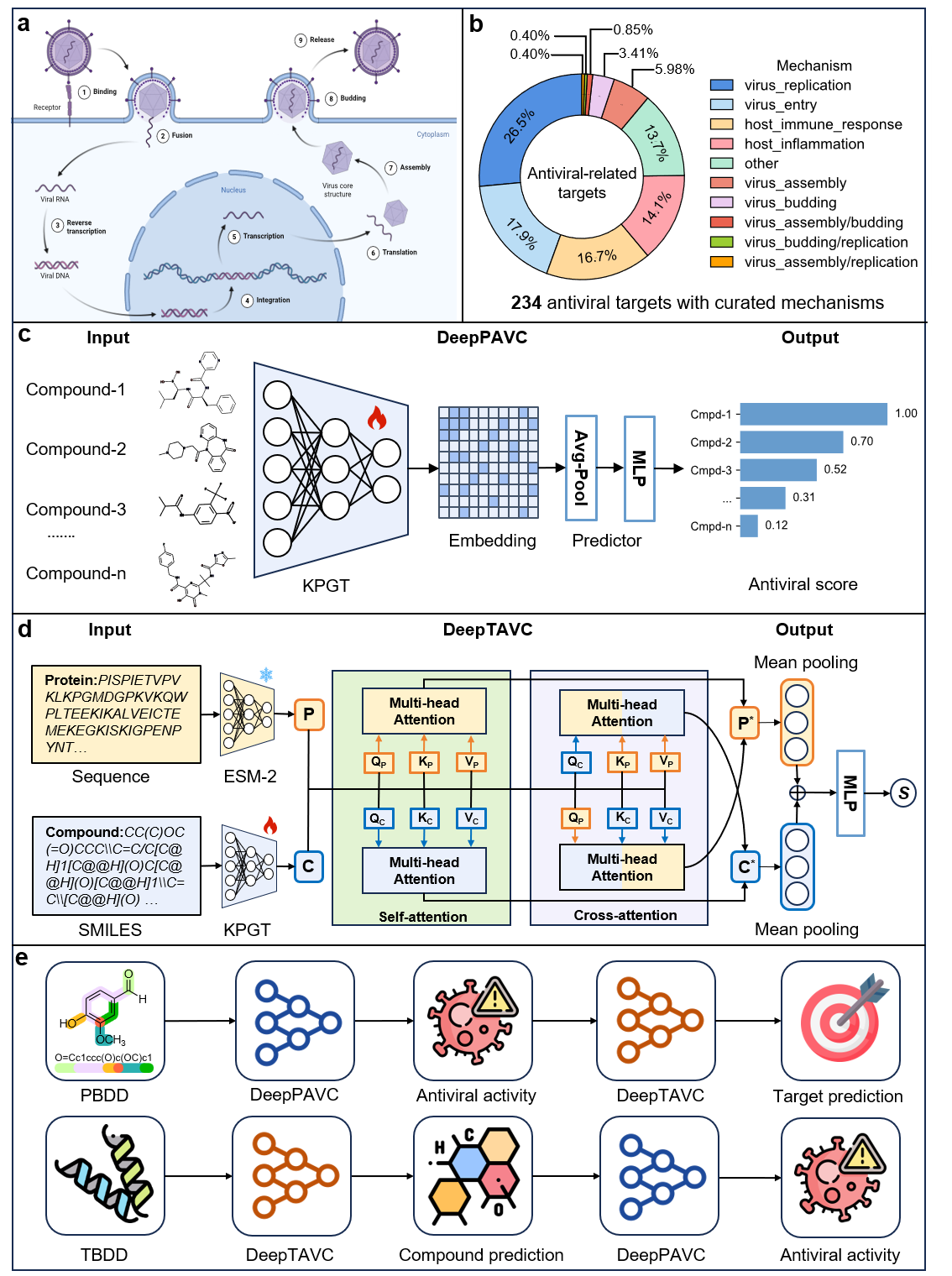
Viral infections continue to pose major threats to global health, underscoring the urgent need for more effective antiviral therapeutics. Antiviral drug discovery traditionally follows two paradigms: phenotype-based drug discovery (PBDD) and target-based drug discovery (TBDD). Here, we present DeepAVC, a large language model (LLM)-powered unified framework that integrates DeepPAVC for PBDD and DeepTAVC for TBDD, enabling complementary and end-to-end antiviral compound prediction.
Users only need to input compounds in SMILES format. DeepPAVC predicts antiviral activity at the phenotype level, while DeepTAVC estimates interactions with known antiviral targets. For large-scale proteome-wide profiling, the CADTI module supports compound–all-target interaction prediction. These three modes can be used independently or in combination to meet diverse research needs.
Latest Highlights
- Manuscript Accepted & Published (≈ 2026)
- DeepAVC Web Server Released (Feb 2025)
- Models Trained & Validated (Nov 2024)
- Algorithm Built & Optimized (Oct 2024)
- Original Idea Proposed (Sep 2024)
Contact Us
Prof. Qinghua Cuicuiqinghua@bjmu.edu.cn
Dr. Boming Kang
kangbm@bjmu.edu.cn
Peking University Health Science Center
Predict Your Compounds
Enter your compounds in SMILES format and select the prediction task below.
Download Pre-trained Models & Source Code
DeepPAVC Model
Download the pre-trained DeepPAVC model for phenotype-based antiviral compounds prediction.
DeepTAVC Model
Download the pre-trained DeepTAVC model for target-based antiviral compounds prediction.
CADTI Model
Download the pre-trained CADTI model for general compound-protein interaction prediction.
KPGT Model
Download the pre-trained KPGT model for compound feature extraction.
ESM-2 (650M)
Download the pre-trained ESM-2 (650M) model for protein feature extraction.
ESM-2 (650M) Contact Regression
Download the pre-trained ESM-2 (650M) model for protein feature extraction.
ESM-2 Model (15B)
Download the pre-trained ESM-2 (15B) model for protein feature extraction.
ESM-2 (15B) Contact Regression
Download the pre-trained ESM-2 (15B) model for protein feature extraction.
Source Code
DeepAVC-main
Download the source code of DeepAVC.
The source code for the DeepAVC algorithm is also available on GitHub.
Help & Instructions
Introduction
Viral infections pose ongoing threats to human health, emphasizing the continued need for effective antiviral therapeutics. Antiviral drug discovery traditionally follows two paradigms: phenotype-based drug discovery (PBDD) and target-based drug discovery (TBDD).
DeepAVC is a unified large language model-powered framework integrating DeepPAVC (phenotype-based prediction) and DeepTAVC (target-based prediction). The framework enables end-to-end antiviral compound discovery from phenotype screening to target interaction prediction.
Workflow Overview
Prediction Tutorial
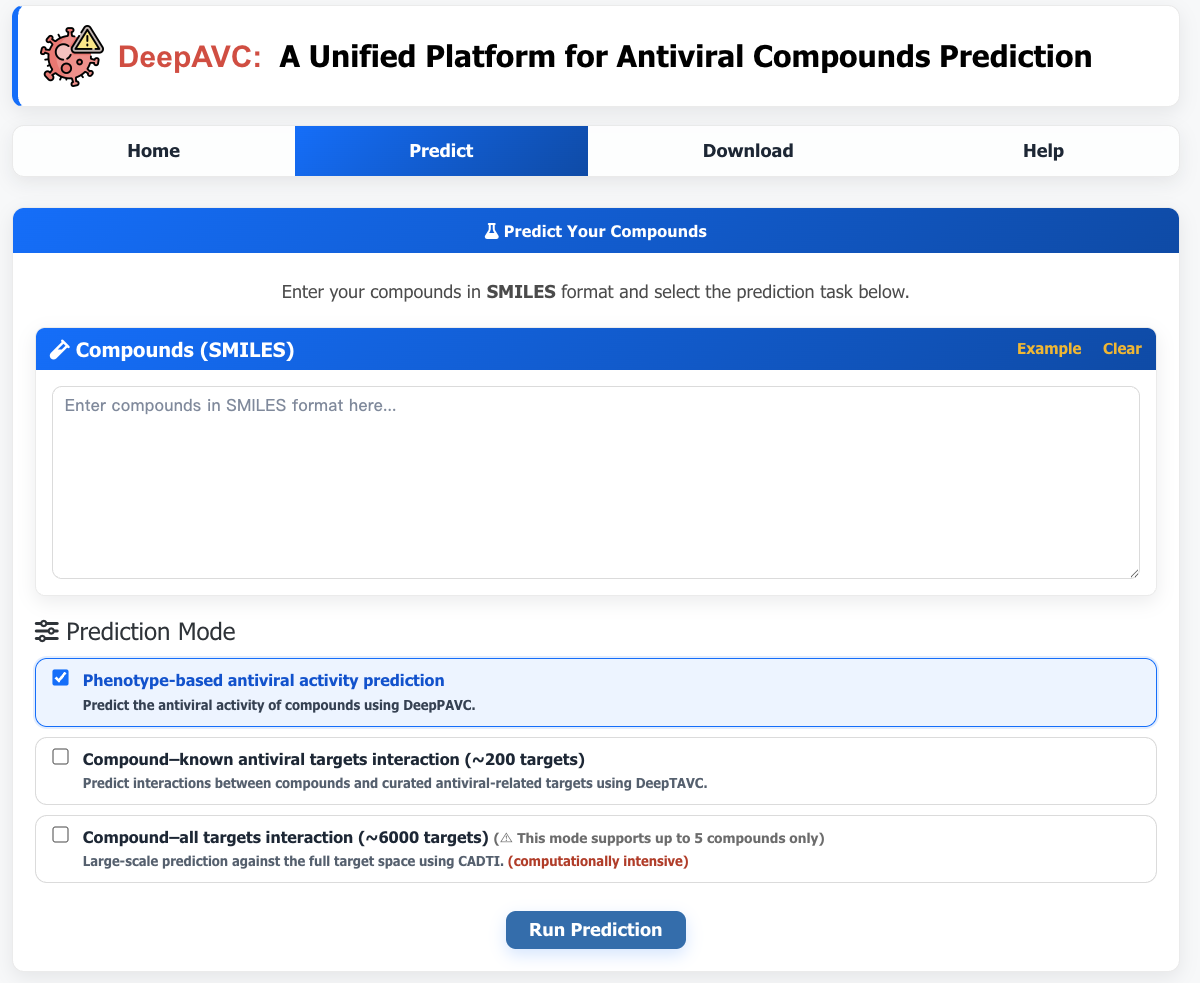
Step 1. Input Compounds in SMILES Format
Enter one compound per line in the SMILES input box. You may click the Example button to load sample compounds.
- ✔ One SMILES per line
- ✔ Supports batch prediction
- ✔ Example button provides valid input format
Step 2. Select Prediction Mode (Multiple Selection Supported)
After entering SMILES, select one or more prediction modes based on your research needs.
- DeepPAVC – Phenotype antiviral activity prediction
- DeepTAVC – Known antiviral target interaction prediction
- CADTI – Proteome-wide interaction prediction
Step 3. Run Prediction
Click the Run Prediction button to submit your job. The server will process the input and display prediction results automatically.
⚠ Note: All-target prediction is computationally intensive and supports limited compound input.
Results
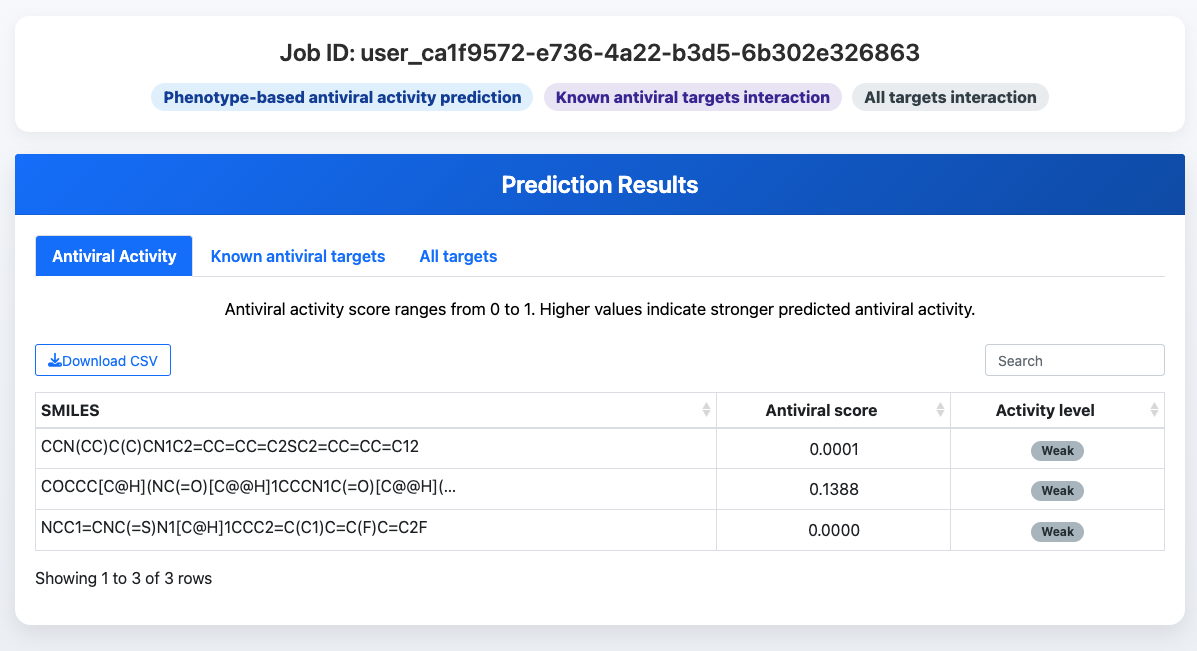
1. Phenotype-based Prediction Results
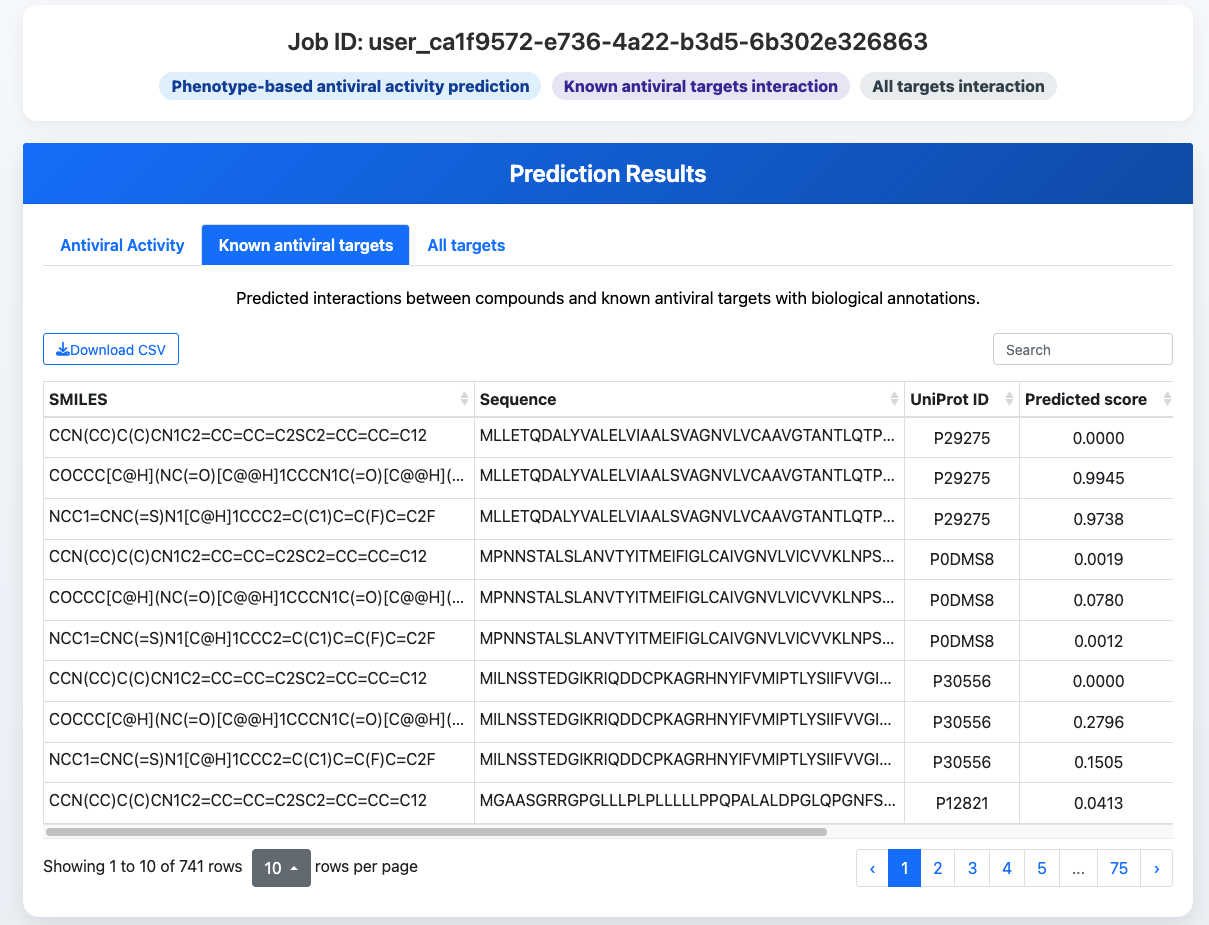
2. Antiviral-related Target Prediction Results
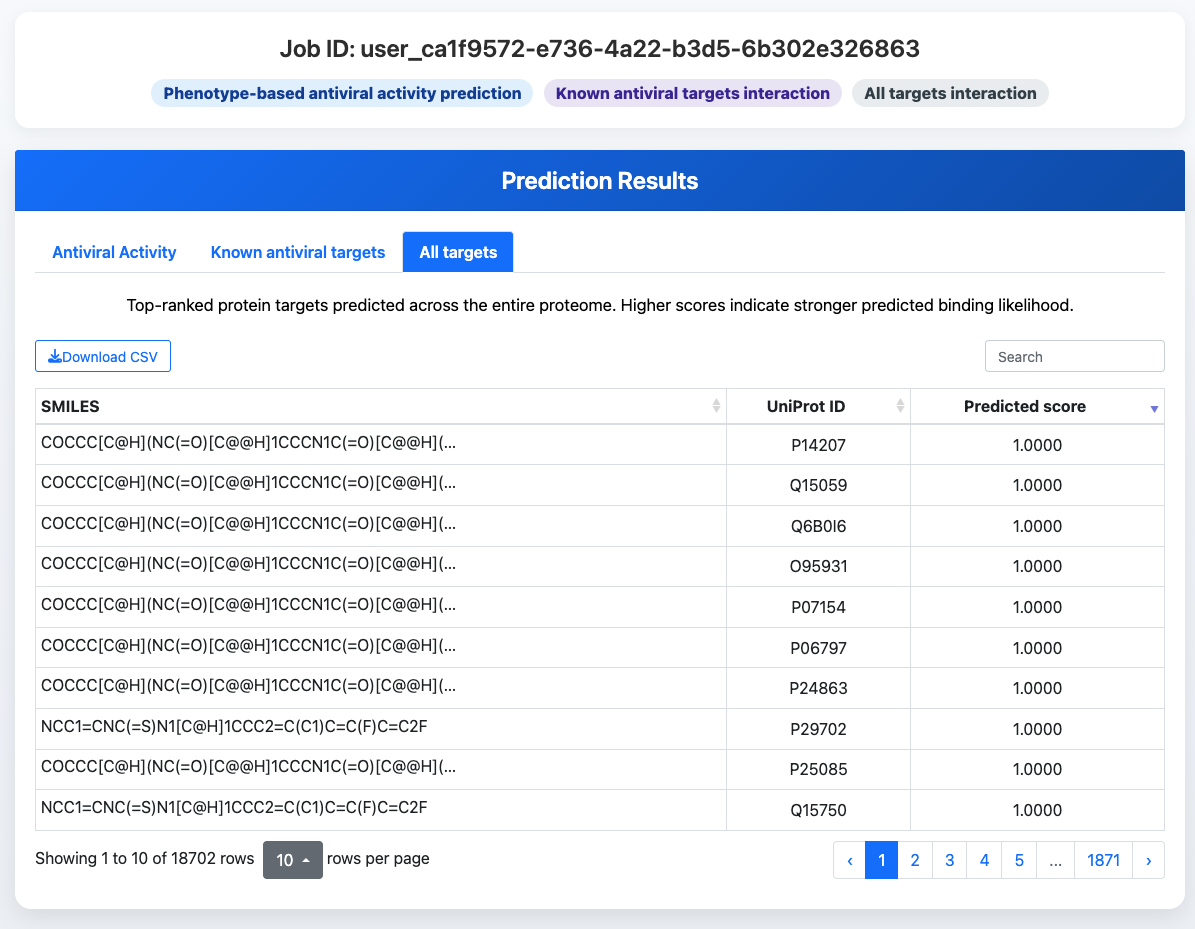
3. Target-based Prediction Results
Results Interpretation
- DeepPAVC score: A normalized score in [0, 1] predicted by DeepPAVC that reflects the likelihood of antiviral activity at the phenotype level. Higher values indicate stronger predicted antiviral potential.
- DeepTAVC score: A normalized score in [0, 1] predicted by DeepTAVC that reflects the likelihood of interaction between the compound and a curated antiviral-related target. Higher values indicate stronger predicted interaction probability.
- CADTI score: A normalized score in [0, 1] predicted by CADTI that estimates the likelihood of interaction between the compound and each target in the proteome-wide target space. Higher values indicate stronger predicted interaction probability.